How applied AI is changing humanitarian response
Applied AI helps humanitarian organisations act faster and more effectively by turning complex crisis data into actionable insights, writes Somesh Utkar.
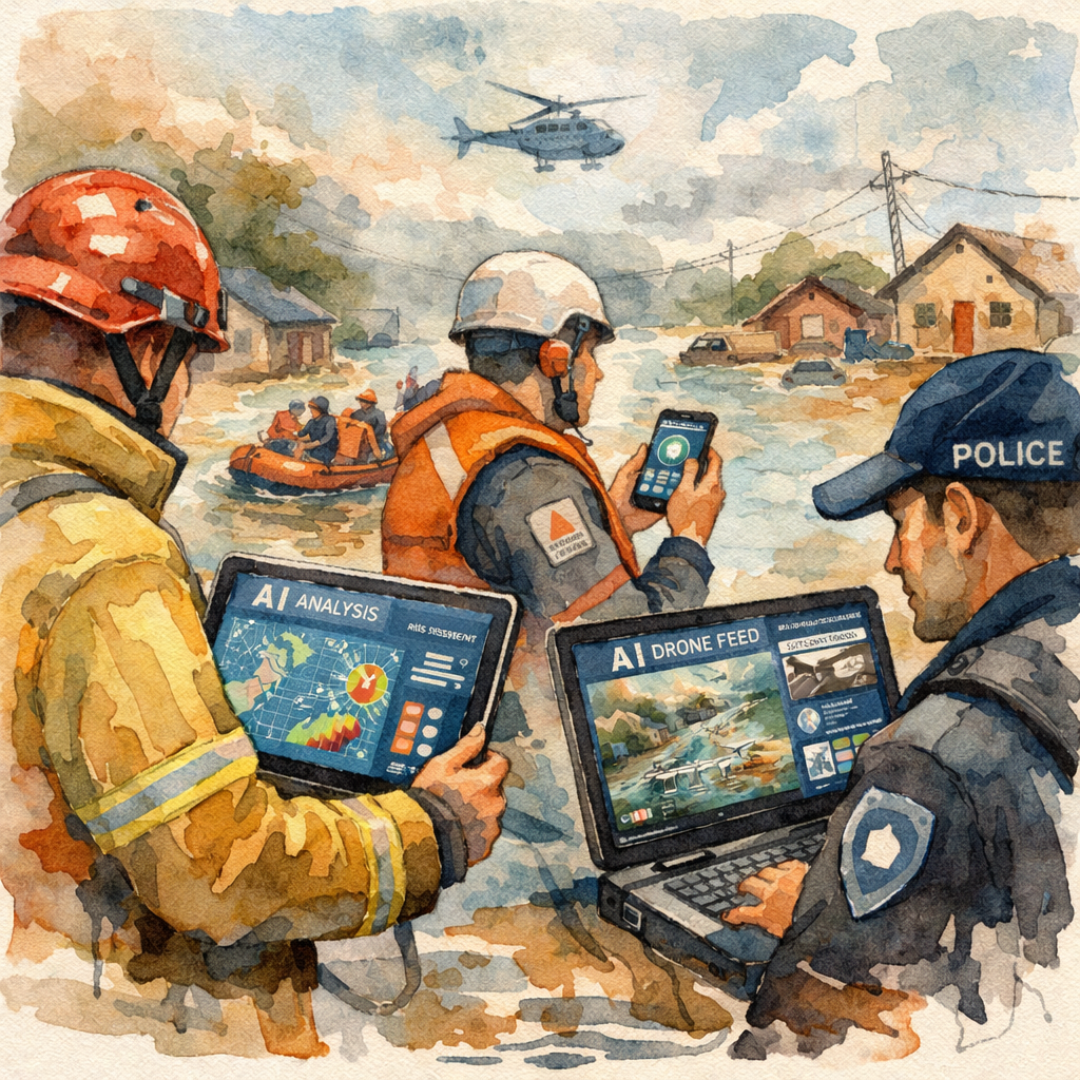
Visual: AI-generated artwork
Humanitarian crises are unfolding with increasing speed, scale, and complexity. Climate-driven disasters, conflict, displacement, and compounding vulnerabilities frequently overlap, placing intense pressure on humanitarian decision-makers who must act quickly with limited and often fragmented information. In this environment, applied artificial intelligence is emerging as a practical decision-support tool, helping organisations make sense of complexity, reduce uncertainty, and improve the quality and timing of critical decisions.
One of the most established uses of applied AI in humanitarian response is crisis impact forecasting. These systems rely on AI models trained on historical crisis data, including conflict events, displacement figures, food security indicators, and environmental variables. Rather than producing definitive predictions, these models generate comparative risk scores that help decision-makers identify where conditions are deteriorating most rapidly across locations.
A practical example of crisis impact forecasting was conducted during Omdena's partnership with ACAPS, a humanitarian analysis organisation that supports evidence-based decision-making in complex emergencies. The challenge ACAPS was facing was the difficulty of prioritising attention across rapidly evolving crises where conflict, displacement, food insecurity, and climate-related risks overlap and change quickly across locations.
To address this, a proof of concept project focused on forecasting crisis impacts to support humanitarian decision-making was created, where supervised machine learning models were developed using historical humanitarian data, including conflict event datasets, displacement figures, food security indicators, and environmental variables. The models synthesised these inputs into a single analytical view that highlighted relative changes in risk across geographic areas, rather than attempting to predict exact outcomes.
These outputs were, then, used by analysts to support earlier situational awareness and more structured planning discussions. By bringing multiple data sources together, the approach helped decision-makers prioritise monitoring efforts and preparedness actions earlier in the crisis cycle, reducing reliance on fragmented anecdotal reporting during the most time-critical phases of response.
Looking ahead, this type of forecasting can increasingly support continuous risk monitoring by incorporating updated field reports and near real-time indicators, enabling analysts to track how risk evolves over time rather than relying on periodic assessments alone.
Once emerging risks are identified, the challenge shifts from understanding where needs may arise to co-ordinating information and resources quickly and effectively across multiple actors.
Applied AI has also demonstrated value in addressing long-standing co-ordination and resource allocation challenges. During emergencies, information about needs, available resources, and organisational capacity is often captured in unstructured text across different systems, emails, and situation reports, making it difficult for response teams to maintain a timely and comprehensive overview during surge periods.
A practical example of AI-supported co-ordination was developed through work led by Women in Data, focused on addressing the challenge of matching humanitarian needs with available resources during emergency surge periods. In these settings, critical information was scattered across unstructured emails, situation reports, and co-ordination messages, slowing response and increasing the risk of duplicated effort.
In response, AI was used to bring structure to large volumes of fragmented text-based information. Natural language processing techniques were applied to extract key attributes such as location, urgency, and type of assistance from incoming requests, which were then compared against structured descriptions of available resources using similarity-matching algorithms.
As a result, co-ordination teams were able to reduce manual sorting time, identify relevant matches more consistently, and improve transparency across stakeholders. The approach supported faster response alignment and reduced duplication of effort during periods of high information volume, allowing experienced staff to focus more on oversight and decision-making rather than information management.
As these systems evolve, incorporating feedback from co-ordination teams on which matches proved most useful could further refine matching logic over time, improving reliability and relevance during prolonged or large-scale response operations.
While co-ordination challenges dominate many response phases, the earliest moments of sudden-onset disasters present a different problem: understanding physical effects before field assessments are possible.
In disaster preparedness and early response, applied AI is increasingly used to enhance early warning and rapid impact assessment, particularly for hazards such as floods and cyclones. These applications commonly combine time-series forecasting models applied to meteorological data with computer vision techniques used to analyse satellite imagery.
Applied AI has also been used to support early warning and rapid damage assessment in collaboration with the World Food Programme, particularly in disaster-prone contexts affected by floods and cyclones. The operational challenge was the delay in generating an initial picture of effect when ground assessments were slow or infeasible due to scale or access constraints.
To address this, time-series forecasting models were applied to meteorological data to estimate hazard likelihood and potential exposure ahead of events, while computer vision models analysed pre- and post-event satellite imagery to identify changes in flood extent and affected infrastructure. This combined approach enabled early assessment before comprehensive field data became available.
In operational use, these AI-supported assessments helped response teams prioritise areas for follow-up, guide deployment of assessment teams, and inform early response planning. The primary effect was a faster and more structured understanding of likely needs during the critical early days of an emergency, when decisions must be made under severe time pressure.
Across these applications, several important lessons have emerged about the use of applied AI in humanitarian settings. While AI can help structure complex information and reduce uncertainty, its effectiveness is fundamentally constrained by the quality and coverage of available data.
In practice, data gaps and reporting biases have limited model reliability in certain contexts. For example, in regions affected by protracted conflict or weak data infrastructure, displacement and needs data may be incomplete or significantly delayed. When models are trained on such data, they may underestimate risk in precisely the areas where visibility is lowest, potentially reinforcing existing blind spots rather than addressing them.
For this reason, successful implementations emphasise interpretability, conservative use of outputs, and strong human oversight. AI-generated insights are treated as early signals that prompt further investigation rather than definitive answers. This approach allows organisations to benefit from analytical efficiency while retaining contextual judgement and accountability.
When used responsibly, applied AI helps humanitarian organisations reduce uncertainty, structure complex information, and act earlier and more effectively in rapidly evolving crises. Its value does not lie in replacing human judgement, but in strengthening it by providing clearer and more timely insights under pressure.
As humanitarian challenges continue to grow in complexity, applied AI is likely to play an increasingly important role in supporting decision-makers to act with greater speed, clarity, and confidence, provided it remains grounded in real-world workflows and supported by high-quality data.
Somesh Utkar is a content creator and SEO specialist at Omdena, working on applied AI, humanitarian response, and data-driven storytelling.